Rising Again
COVID-19 cases are ascent again in Europe. Just what does that hateful for the U.S.?
"*Now* is key moment to human activity."
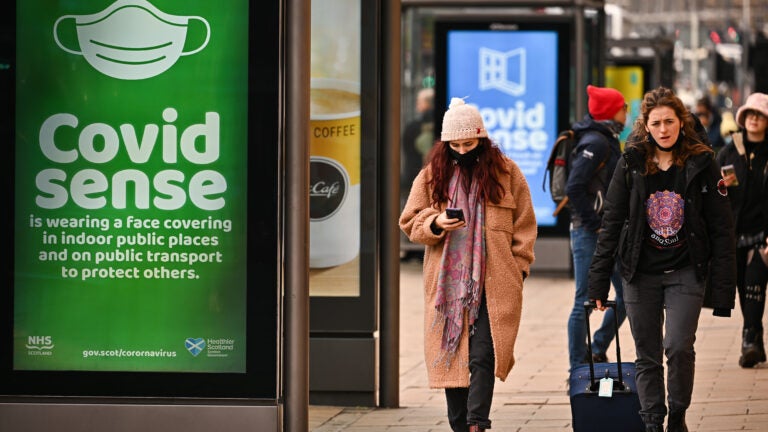
While COVID-19 cases have connected falling across the U.s.a., much of Europe is seeing a different trend.
Daily cases are rising in more than than one-half of the countries in the European Marriage and the United Kingdom, according to CNN.
The rising cases are prompting some to raise concerns that the trend overseas may be a prediction of what'south to come in the U.South., and experts have begun weighing in on what Europe'due south numbers could mean and what should exist watched for in the coming weeks.
-

'I remain very concerned': Local public wellness experts say now is the fourth dimension to foreclose futurity surges
Andy Slavitt, a former senior advisor on COVID-19 in the Biden administration, took to Twitter on Monday to explicate what a time to come U.South. wave might look like.
Based on instance numbers in Germany and the United Kingdom, he outlined that the increases away are existence caused by BA2, which he called a variant of omicron. The more than infectious BA2 variant accounts for more than 50% of cases in Germany and the Britain, unlike the U.S. where it currently accounts for 10%, according to Slavitt.
"Every bit nosotros take seen throughout the pandemic, the US [has] followed Europe by several weeks in our waves of cases," he wrote. "That may happen again hither. But what happens next is going to be different in every country based on what happened this terminal yr."
He said the proportion of a land's population that has already been infected with omicron (estimated at 45% in the U.Southward. co-ordinate to Slavitt), the per centum of vaccinated individuals, and the state of the nation's hospitals volition all exist key in determining how a surge plays out.
Slavitt said that those who are fully vaccinated, but did not get infected with omicron, "should be vulnerable to infection from BA2" only not equally likely to go severely ill.
The former adviser to Biden wrote that we could come across an increase in cases only a lower proportion of hospitalizations compared to the last wave of infections.
"Don't allow public attitudes beguile ii realities nosotros need to go on in mind," Slavitt tweeted. "First is the virus volition continue to mutate with unknown outcomes. This is predictable. This is not owned behavior. Second is that the majority moving on doesn't mean everyone is moving on or can movement on."
For vulnerable populations, including kids under 5, Slavitt wrote that "things haven't changed. Only the people effectually them have."
Slavitt isn't the simply expert keeping an eye on Europe.
Boston University banana professor in the School of Public Wellness Julia Raifman, warned on Twitter of the possibility of an incoming surge — and pointed to wastewater data as an indicator.
Co-ordinate to Raifman, 37% of waste material h2o sites are seeing increases of COVID-19 levels and that, combined with surges abroad, is reason for concern.
Raifman wrote on Monday that, "*Now* is cardinal moment to act."
"I don't desire to wait & encounter what BA2 does after BA1 took 150K lives, hundreds of children, in a matter of weeks," Raifman said. "Let's come together to reduce the toll of the next surge for health, lives, health care workers, & society."
Experts consider wastewater information an unbiased indicator of the state of the pandemic because it is non affected by testing rates or who has access to testing. A month ago Boston-expanse wastewater data was promising — it showed the city was back at levels like to final fall pre-omicron. The information is still looking good for Massachusetts; Biobot, a Cambridge company that tracks the concentration of COVID-19 in wastewater across the country, continues to show low levels of coronavirus detected.
But public health experts are standing to urge for pro-active measures to forbid and respond to future surges.
In a Washington Post op-ed concluding week responding to the Middle for Illness Command and Prevention's new COVID-19 guidelines, Raifman and Elanor Murray, an assistant professor at BU and an epidemiologist, called for quicker methods to reinstate public health measures in the face of surges.
"A recommendation for universal masking should turn on when example counts alone are on the rise, fifty-fifty if they are not yet loftier," the pair wrote. "In the context of a highly transmissible variant such as omicron, just a one-week delay in implementing command measures could lead to twice as many cases, as well as to preventable hospitalizations and deaths (which practise not follow cases in a ane:one human relationship)."
The time for action is now, says Raifman.
Dr. Megan Ranney, an emergency doc and acquaintance dean of the Dark-brown University Schoolhouse of Public Health, said on Twitter that she is tracking cases in Europe only that the indicators are more nuanced than just example counts.
If cases continue to abound, she said she is more focused on how loftier they rise and if the increment affects hospitalizations in "meaningful ways."
"But as always ➡️ set up for the worst, hope for the all-time," Ranney wrote.
Newsletter Signup
Stay up to appointment on all the latest news from Boston.com
Chat
This discussion has ended. Please join elsewhere on Boston.com
Source: https://www.boston.com/news/coronavirus/2022/03/15/covid-19-cases-are-rising-again-in-europe-but-what-does-that-mean-for-the-u-s/
0 Response to "Rising Again"
Post a Comment